

How can we express thanks for an inexpressible gift? If someone brings a turkey to Thanksgiving dinner, we easily find words to describe the gift and convey our gratitude: “Thank you for bringing this large, ground-feeding bird of the Meleagris family, of which the colorful males have a prominent snood hanging from the beak.” Because the gift of a turkey is very describable, we can thank the person who brings it to our dinner party.
But an inexpressible gift, an indescribable gift, is one that, by definition, cannot be put into words. It exceeds the boundaries of our understanding. So, how would you give due and proper thanks for such a gift? Such is the thanksgiving conundrum we face in 2 Corinthians 9. “Thanks be to God,” says St. Paul, “for his inexpressible gift!” (2 Cor. 9:15)
Lack of thanksgiving is, sadly, the norm. When the Israelites come into the promised land, they are stunned at what they see: brooks and fountains in valleys and hills, wheat and barley, vines, fig trees and pomegranates, olives and honey, bread without scarcity, stones of iron, hills with copper (Deut. 8:7–9). Moses knows the proper response: “Thanks be to God!” God is the one who brought you through the desert. God is the one who gave you these gifts. Don’t you make the mistake of pridefully boasting of gifts you received: “Take heed lest you forget the Lord your God” (8:11). “Beware lest you say in your heart, ‘My power and the might of my hand have gotten me this wealth’” (8:17). Pride stands in the way of thanksgiving.
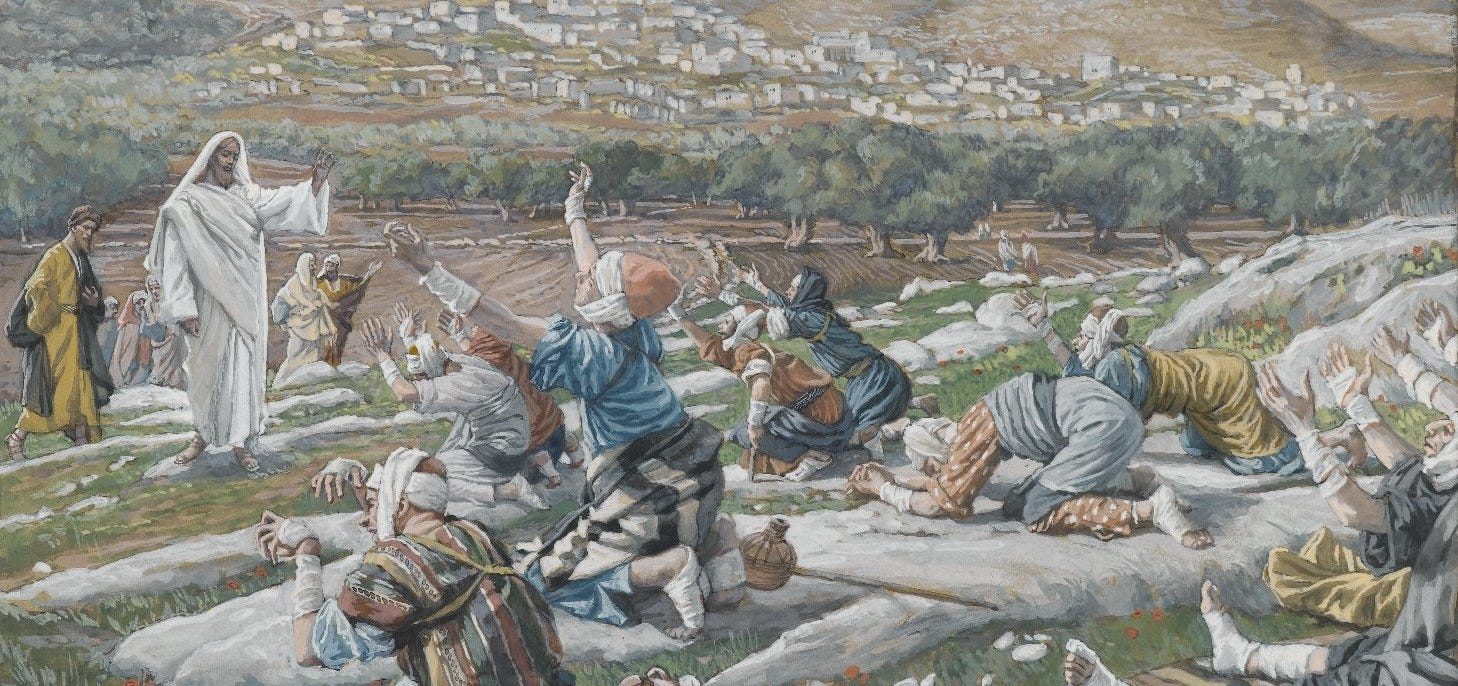
When Jesus heals ten lepers of their sickness, only one turns back, “praising God with a loud voice,” falling on his face at Jesus’s feet, “giving him thanks” (Luke 17:16). He was not what one might call a regular churchgoer. “Were not ten cleansed? Where are the nine? Was no one found to return and give praise to God except this foreigner?” (17:17–18) The Samaritan gives thanks, while the others’ presumption stands in the way of their thanksgiving.
Both Deuteronomy 8 and Luke 17 tell of gifts for which to give thanks: the promised land and healing from sickness. The two gifts seem quite different, but some of our thanksgiving lectionaries pair the two readings together. The promised land is the gift the Israelites received after undertaking a long, miserable journey. Health is what the ten lepers received after enduring a chronic, infectious disease.
The Church aims to show us that desert hardship and leprosy are akin to each other. Both speak to the evil and hardship that at times make our lives unbearable. The promised land’s abundance and newfound health from sickness are also akin to each other. Both picture our new life in Christ through the Spirit of God. Both Deuteronomy 8 and Luke 17 depict the same trajectory, the same story: from sin to salvation.
Moses uses many words to unpack God’s gift of the promised land. Luke, too, tells an entire story, unpacking Jesus’s gift of bodily healing. Both use a great number of words, for both of these gifts are describable. And because both are describable, the Israelites and lepers could, in principle, thank God for their gifts. If only all of them had.
The gift we receive is not just a promised land. Nor is it merely bodily health. The gift that God gives us in Christ is greater by far.
St. Paul, in his second letter to the Corinthians, asks them to contribute to a collection for the Jerusalem church. How to convince them to part with their money? Paul knows that the only way is to remind them of who their God is. God is Generosity itself. God, Paul says, is able to provide you with every blessing in abundance, so that you may always have enough of everything. God supplies seed to the sower and bread for food; he supplies and multiplies our resources; he increases the harvest of our righteousness. He enriches us in every way (2 Cor. 9:8–11).
If the Corinthians give to the Jerusalem poor, they too will be generous. Their gift is a gift we can put into words, for we can count the money. We can put it in bags and ship it to others in need. All of that can be put into words.
God’s generosity is different. God’s generosity is not like ours. God’s generosity is greater than that of the Corinthians or ours. God’s generosity is beyond telling, beyond words. True, God’s generosity is a promised land; God’s generosity is a new body. But land and body are words that can only hint at a reality that itself is greater—the Generosity that is God’s very own self.
As Paul puts it, “You know the grace of our Lord Jesus Christ, that though he was rich yet for your sake he became poor, so that by his poverty you might become rich” (8:9). This is how generous God is. He becomes poor that we might become rich. He becomes man that we might become God.
How ought we to give thanks? With the best words we can find!
Today is Thanksgiving. Today, we obey the apostle; we join him in saying, “Thanks be to God for his inexpressible gift.” We know that our words fall far short, for the Generosity that is God himself is far beyond words.
God’s gift is the gift that always keeps giving. We too pass on the gift that is God to others around us. When in heavenly glory we see our generous God, we’ll stop using words, for then we will know more than words ever can tell: the reality of the inexpressible gift.
First appeared in First Things