

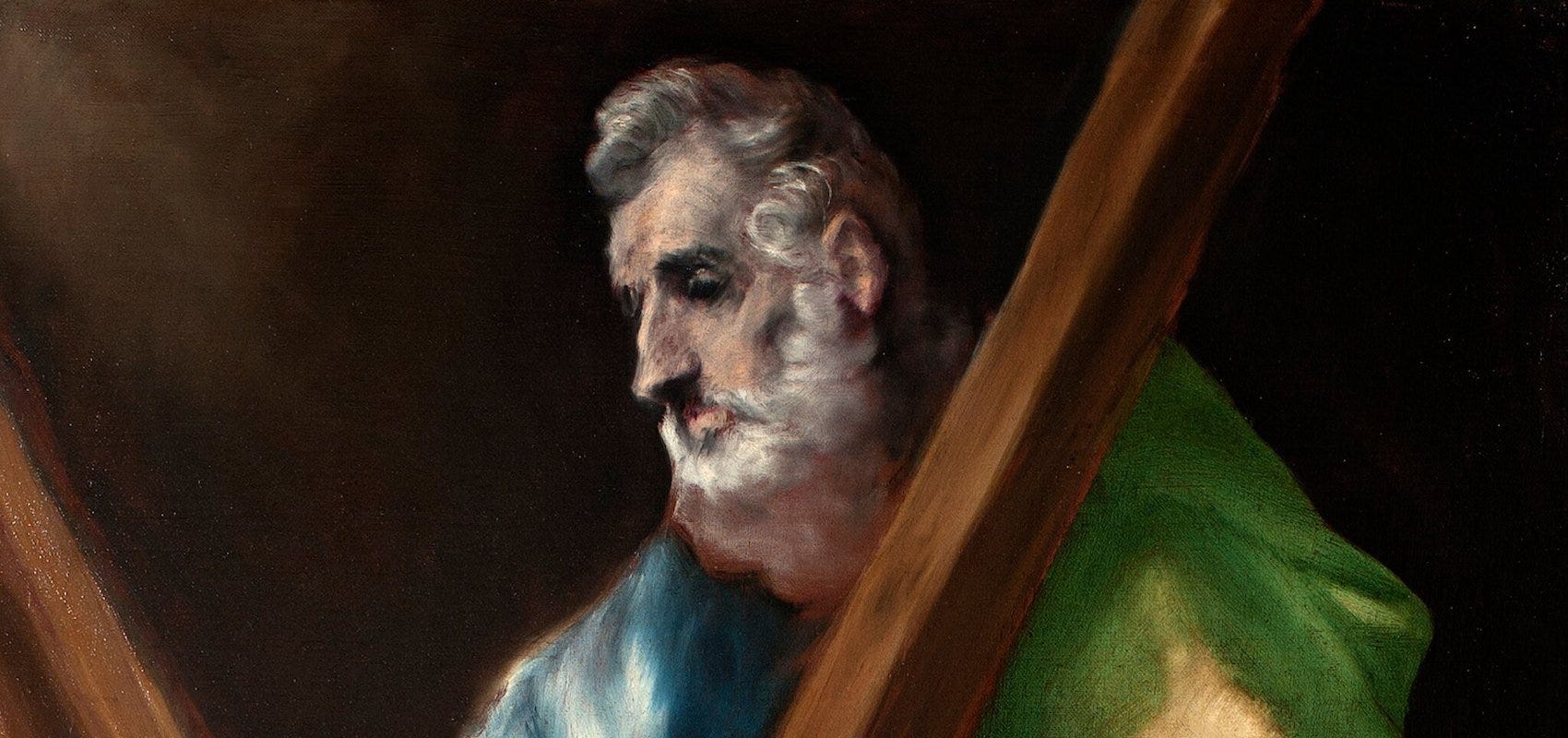
Yesterday, November 30, was the Feast of St. Andrew, Jesus’s first apostle. Why did Jesus call on Andrew to become his first disciple? Matthew’s Gospel gives us a hint.
Peter and Andrew were “casting a net into the sea; for they were fishermen” (Matt. 4:18). So, Jesus makes him (along with Simon Peter) a fisher of men. From catching fish, Andrew will go on to catch disciples.
There is a similarity, to be sure, and the play on words is clear. Andrew’s new fishing job is clarified. But does any of this explain: Why Andrew? Jesus isn’t really suggesting that casting your net into the Sea of Galilee is good preparation for becoming a missionary, is he? Andrew’s “natural job” hardly seems to prepare him for the “supernatural job” Jesus calls him to do. Surely, spending a few years at seminary would better prepare him for the task at hand.
Here is how, in Romans 10, St. Paul quotes Psalm 19: “Their sound has gone out into all lands, and their message to the ends of the world” (Ps. 19:4). Who is “their”? Their sound, their message? It is the heavens and the firmament: “The heavens declare the glory of God, and the firmament shows his handiwork” (19:1). David is talking about “natural” speech: The sound of the heavens has gone out into all lands; the message of the firmament to the ends of the world.
Paul takes this “natural speech” of creation that calls out the glory of God and claims it is actually about the “supernatural speech” of preaching the gospel. We might almost think that the apostle would’ve been better off quoting something from the second part of Psalm 19, for that is all about the “supernatural,” about the commandments of the law. But as it is, Paul says that the “natural” speech of creation is actually about the “supernatural” speech of the gospel.
The apostle is not making a mistake. He recognizes how David has structured his psalm. And he is also familiar with God’s natural speech of the heavens and the firmament. The same is true with Jesus. He is not making a mistake. He knows the world from which he calls his first disciple. And he is also familiar with the natural job of catching fish.
Nature, God’s first book, really does speak to us. Heavens declare and firmament shows. One day tells its tale to another; one night imparts knowledge to another. What language do they speak? Paul knows: Their natural words already contain the gospel of Christ.
Why Andrew? Why did Jesus call him? Perhaps Andrew’s “natural” job was not just natural. Perhaps the Spirit guided his hands from day to day as he loaded his nets full of fish. Perhaps God meant for Andrew every day to toss his nets into the lake as his seminary training, equipping him to become a fisher of men.
Within a few years’ time, Andrew started fishing north of the Black Sea, in Romania, Ukraine, and Russia. Where his brother Simon Peter became the first bishop of Rome, Andrew became the first bishop of Byzantium—the first patriarch of Constantinople, we might say. One huge catch in one large net: East and West united in Andrew and Peter.
May the God of all grace—for whom the language of nature spreads the gospel abroad and for whom nets full of fish are a parable for the gathering of the nations—turn every word that we speak and every work that we do into a sign of supernatural grace. St. Andrew, pray for us.
First published in First Things.
Father, this resonated with me deeply. I'm a plumber by trade, a career I chose over pastoring (and thanks be to God: I was barely an adult when I hit that fork in the road and was not ready to pastor anyone, even though my tradition would have allowed it). It is precisely through plumbing that God has taught me how to be a Christian - and, God willing, a pastor.
I hadn't considered St. Andrew's story from this angle but I'm glad you had the insight to do so.
Beautiful reflection, Hans! Made me think of a theme I have been reflecting on lately. Namely: the Sanctuary of the Ordinary